It is early afternoon here and the outside air temp is flirting with 90degF, 50% humidity. Most light airplanes are not air-conditioned and, if you are flying them in such a direction that the sun pours through the windows, it's like riding in an Easy-Bake Oven, with the added joy of solar convective turbulence.
Better to go flying as early in the morning as possible. Which is what I did today. The airplane was refueled, tied down and I was home by 11.
The good news is that the mud daubers have given up trying to build their nest inside one of the fuel quick-drains. Every other preflight this month has involved removing that crap from the drain.

Tuesday, July 19, 2011

Friday, July 15, 2011
One of the Joys of Ownership
Washing the airplane:
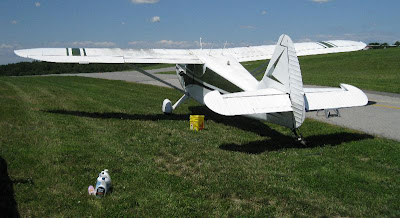
Not seen are the hose and the long-handled brush.
The airplane was filthy, I haven't washed it in awhile. I sprayed Simple Green Aircraft Wash directly on it, then scrubbed with a water-Simple Green mixture.
Washing an airplane is hot, hard work. It's like hand-washing several cars at once. I didn't wax it; the paint is pretty crappy and wax would not help at this point. But it is still a few shades brighter than it was this morning.
I flew it for a bit afterwards to make sure that it was completely dry.

Not seen are the hose and the long-handled brush.
The airplane was filthy, I haven't washed it in awhile. I sprayed Simple Green Aircraft Wash directly on it, then scrubbed with a water-Simple Green mixture.
Washing an airplane is hot, hard work. It's like hand-washing several cars at once. I didn't wax it; the paint is pretty crappy and wax would not help at this point. But it is still a few shades brighter than it was this morning.
I flew it for a bit afterwards to make sure that it was completely dry.
Friday, July 1, 2011
Bugs
Turned out that the problem was a species of bug known as a mud dauber. I knew that they will build nests inside of pitot tubes (which is why aircraft owners should keep them covered if the airplane isn't being used), but I had never heard of them building a nest inside of a fuel quick-drain.
A friend advised me to take a paper clip, unbend one end and poke around in the opening. Sure enough, bits of mud and dirt came out. I stirred the wire around and then the mess just flushed out with the fuel sample.
So I went flying! The winds went from calm when I left to "hold onto your hat, Hannah" in an hour. They weren't too bad of a crosswind, though, so the only real joy was wrestling with the cabin cover to put it back on.
A friend advised me to take a paper clip, unbend one end and poke around in the opening. Sure enough, bits of mud and dirt came out. I stirred the wire around and then the mess just flushed out with the fuel sample.
So I went flying! The winds went from calm when I left to "hold onto your hat, Hannah" in an hour. They weren't too bad of a crosswind, though, so the only real joy was wrestling with the cabin cover to put it back on.
Thursday, June 30, 2011
Bummer
I was away for two weeks, so the other day I went to go flying.
At least that was my intention. Hardly any gas dribbled out of the test drain for one tank. My first thought was "gorrammit, somebody stole my gas", but then I "sticked" the tank and saw that the tank was three-quarters full. So either the quick-drain is FUBAR or there is something in the tank. I don't have the capability to remove the drain and then catch 15 gallons of avgas flowing out of the tank like some fratboy shotgunning a beer.
I re-tied the airplane back down, put in a call to the shop and went home.
At least that was my intention. Hardly any gas dribbled out of the test drain for one tank. My first thought was "gorrammit, somebody stole my gas", but then I "sticked" the tank and saw that the tank was three-quarters full. So either the quick-drain is FUBAR or there is something in the tank. I don't have the capability to remove the drain and then catch 15 gallons of avgas flowing out of the tank like some fratboy shotgunning a beer.
I re-tied the airplane back down, put in a call to the shop and went home.
Monday, May 30, 2011
W00t!
I got to go flying today!
It's fairly warm here. It was MVFR until noon, with broken cirrus at 2,300' after that. Flew around for a bit and then shot three landing for the logbook. I did pretty well, even with a seven week layoff from flying.
Feels good, even with gas at $5.80/gal.
It's fairly warm here. It was MVFR until noon, with broken cirrus at 2,300' after that. Flew around for a bit and then shot three landing for the logbook. I did pretty well, even with a seven week layoff from flying.
Feels good, even with gas at $5.80/gal.
Thursday, May 26, 2011
Annual
The airplane still isn't back to me.
That's partially my fault, as I have told the mechanic repeatedly that I won't pay for expedited shipping for parts, unless I specifically approve it. The cost differential for large or heavy stuff isn't worth it to me. Besides the muffler, which I wrote about previously, the gyrocompass shit the bed on my pre-annual test flight. Modern DGs don't seem to be worth a crap. I had an old horizontal card WW2 surplus DG in my plane and it worked up until 2004.

They truly don't make them like that anymore. There were four war-surplus instruments in my airplane when I bought it, now 20 years ago (DG, AI, VSI, altimeter). The altimeter was the last to go. The rebuilding shop wouldn't touch it because it had indicator needles with radium paint on them.
Anyway, I fly for fun. That means that if the mechanic has an airplane come in that somebody uses in a business, it gets priority, and I am cool with that.
But the weather is nice, finally, it's been weeks and I want to go flying.
That's partially my fault, as I have told the mechanic repeatedly that I won't pay for expedited shipping for parts, unless I specifically approve it. The cost differential for large or heavy stuff isn't worth it to me. Besides the muffler, which I wrote about previously, the gyrocompass shit the bed on my pre-annual test flight. Modern DGs don't seem to be worth a crap. I had an old horizontal card WW2 surplus DG in my plane and it worked up until 2004.

They truly don't make them like that anymore. There were four war-surplus instruments in my airplane when I bought it, now 20 years ago (DG, AI, VSI, altimeter). The altimeter was the last to go. The rebuilding shop wouldn't touch it because it had indicator needles with radium paint on them.
Anyway, I fly for fun. That means that if the mechanic has an airplane come in that somebody uses in a business, it gets priority, and I am cool with that.
But the weather is nice, finally, it's been weeks and I want to go flying.
Friday, April 29, 2011
The Five Words That Strike Terror Into the Heart of an Aircraft Owner
"The annual inspection is due."
This is an event that aircraft owners shorten to "annual". It could also be called an "IRAN" for "inspect and repair as necessary", but it is more than that. Depending on the airframe, engine and propeller, there may be periodic detailed inspections, maintenance or even replacement of components. Virtually every production aircraft and engine has inspection guides as to what needs to be looked at, lubricated, or replaced.
The work is done by an airframe & powerplant mechanic, or "A&P". The inspection is done (or at least signed off) by an A&P who has inspection authorization (A&P-IA).
Experimental aircraft do not receive annuals, they receive "condition inspections". The difference is that there is more latitude on what should be done. Condition inspections can be done not only by an A&P, but also by the person who built the aircraft. (The builder receives a repairman authorization that is good for only that aircraft.)
Annuals can run the gamut from paper-pushing exercises to extremely detailed rebuilds. If you own a piston-engined airplane, a bad thing to do is to take it to a shop that does a lot of work on turbine-powered airplanes, as their view of what is a reasonable cost and your view will differ.
One of the biggest cons in the aircraft dealing racket are the words "fresh annual", for it means nothing. I've seen mechanically sound airplanes that, from the exterior, look like flying bales of scrap. I've seen very pretty looking airplanes that were sold with a "fresh annual" and which needed five figures' worth of repair work soon afterwards. Caveat emptor rules in buying aircraft.
So far, one of the mufflers needed to be rebuilt. That was sent off by surface freight, I'm not in a hurry as to justify shipping big metal parts by second day air.
This is an event that aircraft owners shorten to "annual". It could also be called an "IRAN" for "inspect and repair as necessary", but it is more than that. Depending on the airframe, engine and propeller, there may be periodic detailed inspections, maintenance or even replacement of components. Virtually every production aircraft and engine has inspection guides as to what needs to be looked at, lubricated, or replaced.
The work is done by an airframe & powerplant mechanic, or "A&P". The inspection is done (or at least signed off) by an A&P who has inspection authorization (A&P-IA).
Experimental aircraft do not receive annuals, they receive "condition inspections". The difference is that there is more latitude on what should be done. Condition inspections can be done not only by an A&P, but also by the person who built the aircraft. (The builder receives a repairman authorization that is good for only that aircraft.)
Annuals can run the gamut from paper-pushing exercises to extremely detailed rebuilds. If you own a piston-engined airplane, a bad thing to do is to take it to a shop that does a lot of work on turbine-powered airplanes, as their view of what is a reasonable cost and your view will differ.
One of the biggest cons in the aircraft dealing racket are the words "fresh annual", for it means nothing. I've seen mechanically sound airplanes that, from the exterior, look like flying bales of scrap. I've seen very pretty looking airplanes that were sold with a "fresh annual" and which needed five figures' worth of repair work soon afterwards. Caveat emptor rules in buying aircraft.
So far, one of the mufflers needed to be rebuilt. That was sent off by surface freight, I'm not in a hurry as to justify shipping big metal parts by second day air.
Tuesday, April 5, 2011
Narco: Wonderful.
Just Frelling Wonderful.
Narco Avionics has gone out of business.
Speaking as the owner of an airplane with all Narco radios, I sure as hell hope that somebody takes over the repair side of their business.
Speaking as the owner of an airplane with all Narco radios, I sure as hell hope that somebody takes over the repair side of their business.
Thursday, March 17, 2011
Nine Days Later From My Last Post
Today tt was 60degF and sunny. It was a gorgeous day for flying, and I did.
Almost all of the snow that was there nine days ago is gone, only the remnants of large piles and some stuff on north-facing hills remain. The ground alongside the paved areas at the airport is soft and almost squishy.
There is a layer in the atmosphere of brownish shmutz at the surface that goes up a few thousand feet or so. It seems to me that the brown layer is worse this year than in years past.
Almost all of the snow that was there nine days ago is gone, only the remnants of large piles and some stuff on north-facing hills remain. The ground alongside the paved areas at the airport is soft and almost squishy.
There is a layer in the atmosphere of brownish shmutz at the surface that goes up a few thousand feet or so. It seems to me that the brown layer is worse this year than in years past.
Wednesday, March 9, 2011
Winter Flying

That is ice on the trees. It was sunny out, the ice had melted from my airplane where the sun could shine on it. That meant that the right side of the tail and fuselage were covered with about an eighth of an inch of clear ice.
I was able to taxi to another part of the airport and park the airplane to turn that side of it directly into the sunshine. Less than a half-hour later, I was in the air. Overall, though, I spent more time preparing for the flight than I did flying, which is not terribly unusual in the winter.
Avgas here is now $5.30/gal. I can check fuel prices on AirNav, but some of the reports are over three weeks old and given the volatility in fuel pricing, a three week old report is worthless. Unless the price of local fuel is outrageous, I'll buy at my home airport, as I have an interest in seeing that they stay in business.
Anyway, the airports in southeast NY state may see a bit more airplanes on the tiedowns this year. The governor of CT wants to add a personal property tax for airplanes, which will make it attractive for those who can stomach the extra driving time to move them to other states. That'd be good for my airport, but not so good for airports like 11N and DXR.
Thursday, February 17, 2011
Winter Flying
333C is almost ready to go:

Almost. The tailwheel needed to be inflated a bit. The snow berms being what they were, there was no way I could get my car close enough to the tail in order to use my electric tire pump. So I had to move my car to another place on the field and then taxi over there.
Those snow piles are down a good foot from what they were two weeks ago.
I am glad that I had been keeping up with clearing the tiedown and the airplane after each snowfall. Even if I couldn't always get every bit of snow and ice removed, I moved enough so that one warm day was all it took to finish the job. There were pilots out at the airport this time shoveling snow away from their airplanes, while all I had to do was preflight and go flying.
It hit 50degF here today. It was warm enough that I removed my cheapo winterization kit from the oil cooler. The landscape was still covered with snow, though.

There has been enough snow this winter that a day or two of 50 degree temperatures isn't going to change that. But it has been nice that there has been a break from the weekly heavy snow storms that ran through from Christmas to the end of January.

Almost. The tailwheel needed to be inflated a bit. The snow berms being what they were, there was no way I could get my car close enough to the tail in order to use my electric tire pump. So I had to move my car to another place on the field and then taxi over there.
Those snow piles are down a good foot from what they were two weeks ago.
I am glad that I had been keeping up with clearing the tiedown and the airplane after each snowfall. Even if I couldn't always get every bit of snow and ice removed, I moved enough so that one warm day was all it took to finish the job. There were pilots out at the airport this time shoveling snow away from their airplanes, while all I had to do was preflight and go flying.
It hit 50degF here today. It was warm enough that I removed my cheapo winterization kit from the oil cooler. The landscape was still covered with snow, though.

There has been enough snow this winter that a day or two of 50 degree temperatures isn't going to change that. But it has been nice that there has been a break from the weekly heavy snow storms that ran through from Christmas to the end of January.
Sunday, February 6, 2011
I Love It When a Plan Comes Together
Today was supposed to be sunny with strong and gusty winds. The winds died down early this morning. I went to the airport, got most of the snow and ice off the airplane. The Sun did the rest and, while that was happening, I cleared enough of the tiedown to taxi out. That was fun, including freeing the tailwheel from about half an inch of ice.
Took two hours of work, but I got it done. I went to the cafe to rest, had a couple cups of coffee, glanced over the newspaper and then I went flying! I flew for about 1.5 hours and got in three landings.
No photos, unfortunately, I left my camera home.
First flight in a month, too.
Took two hours of work, but I got it done. I went to the cafe to rest, had a couple cups of coffee, glanced over the newspaper and then I went flying! I flew for about 1.5 hours and got in three landings.
No photos, unfortunately, I left my camera home.
First flight in a month, too.
Thursday, February 3, 2011
Ugh.
I went to the airport on Sunday, removed 95% of the snow and ice that was on the airplane. I also shoveled out the tiedown (again).

You can see in comparison to the pictures in my earlier post that the snow berms are getting pretty damn high.
Yesterday, we had about a 1/4" of ice in this area. Even with the engine running and heating the windows, it took me 15 minutes to remove enough ice from my car to be able to drive safely.
I hate to think how long it will take to remove that much ice from my airplane. And more is forecast for Saturday.
This winter is kicking my ass.

You can see in comparison to the pictures in my earlier post that the snow berms are getting pretty damn high.
Yesterday, we had about a 1/4" of ice in this area. Even with the engine running and heating the windows, it took me 15 minutes to remove enough ice from my car to be able to drive safely.
I hate to think how long it will take to remove that much ice from my airplane. And more is forecast for Saturday.
This winter is kicking my ass.
Thursday, January 13, 2011
I Am Getting Too Old For This Mishegoss
It snowed hard here from the evening of the day before yesterday until last morning. This is the scene at Sky Acres:


They do plow the tiedowns, but they don't cut too close to the airplanes, for obvious reasons. I shoveled enough away so when they do plow later today or tomorrow, it will clear the tiedown area. (I also shoveled a path so I could get to it.) Because of drifting, the snow varies from a few inches to well over a foot.

I think I got my exercise in for today.


They do plow the tiedowns, but they don't cut too close to the airplanes, for obvious reasons. I shoveled enough away so when they do plow later today or tomorrow, it will clear the tiedown area. (I also shoveled a path so I could get to it.) Because of drifting, the snow varies from a few inches to well over a foot.

I think I got my exercise in for today.
Monday, January 10, 2011
Sometimes, Sympathy Is Hard to Find
(a whining post, you have been warned)
I went to my home airport yesterday in order to brush the snow from my airplane and to shovel out around the tiedown. The wind was pretty strong, which meant that if I was not careful of where I stood, brushing the snow from the wings meant that I got a faceful of it.
So, after I was done doing that, I went to the airport FBO's building in order to get a cup of hot tea at the cafe.
When I passed through the office, another owner was trying to move to a west-facing hangar as he thought it was too rough to have a hangar that faced to the east.
I thought about that as I walked by, chilled half-way to the bone, that I'd love to be able to afford to keep my airplane in a hangar, regardless of the direction it faced. Life is tough for some people.
So, after I was done doing that, I went to the airport FBO's building in order to get a cup of hot tea at the cafe.
When I passed through the office, another owner was trying to move to a west-facing hangar as he thought it was too rough to have a hangar that faced to the east.
I thought about that as I walked by, chilled half-way to the bone, that I'd love to be able to afford to keep my airplane in a hangar, regardless of the direction it faced. Life is tough for some people.
Sunday, January 2, 2011
Peppermint Oil
In an earlier post, I mentioned that a cotton ball soaked with real peppermint oil was a decent mouse deterrent.
It seems to work.
A few weeks ago, I noticed that the roll of paper towels that I keep in the airplane had been nibbled on. So I got some old knee-high stockings, some cotton balls and peppermint oil. I put one in the baggage compartment and one in the cabin.
The roll hasn't been nibbled on since.
So it does seem to work, but I reiterate that you probably have to go to a health food store to find genuine essential peppermint oil. The synthetic stuff won't do the job.
It seems to work.
A few weeks ago, I noticed that the roll of paper towels that I keep in the airplane had been nibbled on. So I got some old knee-high stockings, some cotton balls and peppermint oil. I put one in the baggage compartment and one in the cabin.
The roll hasn't been nibbled on since.
So it does seem to work, but I reiterate that you probably have to go to a health food store to find genuine essential peppermint oil. The synthetic stuff won't do the job.
Tuesday, December 14, 2010
Cold
Cold weather ops are, well, challenging in an older airplane.
First off, the output by the cabin heater is negligible. I have an insulated jumpsuit that I wear for winter-time flying. Since my airplane has toe-brakes, not heel-brakes, I can get away with wearing insulated boots.
You'll need some kind of head covering and gloves. Sometimes you'll see a pilot getting out of a newer Cessna or Piper and he is putting his coat on. Try not to think evil thoughts towards him. Console yourself with the idea that if you both had forced landings, you're already dressed for it and he is not.
My "winterization kit" for the engine consists of duct-tape over the oil cooler inlet. If the air temperature is below 40F, I cover it completely. The oil temps get to where they need to be (180F). It doesn't get cold enough around here to warrant blocking off parts of the cowling inlets.
If I ever have the funds to repaint the airplane, I am going to paint it in a color other than white. Even a white with a little tinge of yellow, a sort of coffee-cream color, would help in using the Sun to shed ice and snow. But you have to get all of the snow and all of the ice off the airplane. Sometimes that means getting most of it off and then repositioning it to take better advantage of the Sun's rays.
Preheating the engine is a must, in my view, whenever the temperature drops below 32F. If you are at a location without electrical power, you either have to use a combustion-type preheater or an electrical preheater with a portable source of power. Whichever you use, if your engine has a remotely-located oil filter (as mine does), be sure that also benefits from preheating.
And cover the cowling with a blanket while preheating the engine! You can get a cheap blanket from a discount place for that. A nice touch is to get a grommet-inserter from a crafts store, for you can then use bungee cords to hold the blanket in place when there is any bit of wind. (If you'd rather spend the money, an insulated engine cover works.)
What it all means, though, is that for an hour's flight in the wintertime, you can easily spend more than that getting the airplane ready to fly. If there has been snow, you may wind up making an extra trip to the airport to brush the snow off and dig out the tiedown a day or two before. (If the snowplow driver who was doing the taxiway plowed you in and you don't have your own snowblower, you might be SOL until the snow melts, so you may want to have a chat with the FBO's owner about that.)
It can be very pretty to fly over a snow-covered landscape in a light plane.
But if you don't have a hangar and you don't want to take the steps necessary to fly, then pickle your engine late in the Fall. That usually involves draining the oil and replacing it with a preservative oil, putting desiccant plugs in the cylinders, exhaust pipes and inlet manifold, and removing the battery. Your engine will thank you for it.
You also may want to add mouse deterrents. Buy a package of women's knee-high stockings, fill a couple with mothballs, tie them off and put them in the baggage compartment and the cabin. You may also want to think about opening an inspection cover and put one in each wing. If you plan to fly it, you may be better off soaking cotton balls with essential peppermint oil (the real stuff, not the synthetic) and using them instead of mothballs. The smell is better for you, the mice hate it as much and your airplane will smell like a candy cane.
The two coldest pilots I've ever seen where two guys who were ferrying an Aerostar whose Janitrol cabin heater had conked out. They looked like pilot-sicles when they got out of that airplane and the first thing they did, after they got warmed up, was borrow a crew car and head for a sporting goods store to buy proper winter gear. They were on a schedule and they couldn't take the downtime to fix the heater.
I'd ague that a prudent pilot should dress for the outside air temperature and control the cabin temperature accordingly. Forced landings can happen and it would be kind of ironic to get frostbite or hypothermia after successfully executing a forced landing. But it is a pain int he ass to wear that many layers and to fly while so dressed, so most pilots don't bother.
First off, the output by the cabin heater is negligible. I have an insulated jumpsuit that I wear for winter-time flying. Since my airplane has toe-brakes, not heel-brakes, I can get away with wearing insulated boots.
You'll need some kind of head covering and gloves. Sometimes you'll see a pilot getting out of a newer Cessna or Piper and he is putting his coat on. Try not to think evil thoughts towards him. Console yourself with the idea that if you both had forced landings, you're already dressed for it and he is not.
My "winterization kit" for the engine consists of duct-tape over the oil cooler inlet. If the air temperature is below 40F, I cover it completely. The oil temps get to where they need to be (180F). It doesn't get cold enough around here to warrant blocking off parts of the cowling inlets.
If I ever have the funds to repaint the airplane, I am going to paint it in a color other than white. Even a white with a little tinge of yellow, a sort of coffee-cream color, would help in using the Sun to shed ice and snow. But you have to get all of the snow and all of the ice off the airplane. Sometimes that means getting most of it off and then repositioning it to take better advantage of the Sun's rays.
Preheating the engine is a must, in my view, whenever the temperature drops below 32F. If you are at a location without electrical power, you either have to use a combustion-type preheater or an electrical preheater with a portable source of power. Whichever you use, if your engine has a remotely-located oil filter (as mine does), be sure that also benefits from preheating.
And cover the cowling with a blanket while preheating the engine! You can get a cheap blanket from a discount place for that. A nice touch is to get a grommet-inserter from a crafts store, for you can then use bungee cords to hold the blanket in place when there is any bit of wind. (If you'd rather spend the money, an insulated engine cover works.)
What it all means, though, is that for an hour's flight in the wintertime, you can easily spend more than that getting the airplane ready to fly. If there has been snow, you may wind up making an extra trip to the airport to brush the snow off and dig out the tiedown a day or two before. (If the snowplow driver who was doing the taxiway plowed you in and you don't have your own snowblower, you might be SOL until the snow melts, so you may want to have a chat with the FBO's owner about that.)
It can be very pretty to fly over a snow-covered landscape in a light plane.
But if you don't have a hangar and you don't want to take the steps necessary to fly, then pickle your engine late in the Fall. That usually involves draining the oil and replacing it with a preservative oil, putting desiccant plugs in the cylinders, exhaust pipes and inlet manifold, and removing the battery. Your engine will thank you for it.
You also may want to add mouse deterrents. Buy a package of women's knee-high stockings, fill a couple with mothballs, tie them off and put them in the baggage compartment and the cabin. You may also want to think about opening an inspection cover and put one in each wing. If you plan to fly it, you may be better off soaking cotton balls with essential peppermint oil (the real stuff, not the synthetic) and using them instead of mothballs. The smell is better for you, the mice hate it as much and your airplane will smell like a candy cane.
The two coldest pilots I've ever seen where two guys who were ferrying an Aerostar whose Janitrol cabin heater had conked out. They looked like pilot-sicles when they got out of that airplane and the first thing they did, after they got warmed up, was borrow a crew car and head for a sporting goods store to buy proper winter gear. They were on a schedule and they couldn't take the downtime to fix the heater.
I'd ague that a prudent pilot should dress for the outside air temperature and control the cabin temperature accordingly. Forced landings can happen and it would be kind of ironic to get frostbite or hypothermia after successfully executing a forced landing. But it is a pain int he ass to wear that many layers and to fly while so dressed, so most pilots don't bother.
Saturday, November 27, 2010
Sky Acres Airport (44N)
Sky Acres Airport is an airport in Dutchess County, NY. It is popular because it has a restaurant that is open from Thursdays through Sundays (7:30AM to 3PM). In the summer, there is also an ice cream stand that is open from Noon until 8PM.
The airport has a bit of a reputation for being difficult to land at, which is, to my mind, rather undeserved. The runway is almost 4,000 feet long, 60 feet wide, which seems adequate for almost everything not powered by a jet engine. But the runway has a few tricks to keep in mind.
First off, about 60% of it is sloped. Runway 17 slopes up, so you have to account for that in setting up your landing to ensure that you are not fooled by the visual picture and that you flare properly.
Second, Runway 17 has trees off to the right. If you are dealing with a right-hand crosswind on 17, it will die off as you begin your flare.
Third, Runway 35 begins as a flat runway, then slopes down just after the first turn-off (there is about a 50' difference in the elevation of the two thresholds). The flat area is at least 1,400' long. I cannot stress this enough: If your wheels are not fully on the pavement by the time you reach the first turn-off, go around!
Finally, and this is for those departing on Runway 35, you cannot see to the far end of the runway. If someone has landed and doesn't make the first turnoff, you won't be able to see them to verify that the runway is clear. Hopefully they have a radio and are polite enough to report clear.
Sky Acres is nowhere near as challenging an airport as, say, Marlboro, but if you are used to 6,000' x 150' runways, you may want to step up your game before flying in.
The airport has a bit of a reputation for being difficult to land at, which is, to my mind, rather undeserved. The runway is almost 4,000 feet long, 60 feet wide, which seems adequate for almost everything not powered by a jet engine. But the runway has a few tricks to keep in mind.
First off, about 60% of it is sloped. Runway 17 slopes up, so you have to account for that in setting up your landing to ensure that you are not fooled by the visual picture and that you flare properly.
Second, Runway 17 has trees off to the right. If you are dealing with a right-hand crosswind on 17, it will die off as you begin your flare.
Third, Runway 35 begins as a flat runway, then slopes down just after the first turn-off (there is about a 50' difference in the elevation of the two thresholds). The flat area is at least 1,400' long. I cannot stress this enough: If your wheels are not fully on the pavement by the time you reach the first turn-off, go around!
Finally, and this is for those departing on Runway 35, you cannot see to the far end of the runway. If someone has landed and doesn't make the first turnoff, you won't be able to see them to verify that the runway is clear. Hopefully they have a radio and are polite enough to report clear.
Sky Acres is nowhere near as challenging an airport as, say, Marlboro, but if you are used to 6,000' x 150' runways, you may want to step up your game before flying in.
Sunday, November 21, 2010
No, I'm Not That Crazy
It's a nice day, temps in the mid forties. Blue sky, no wind to speak of. At my home airport, they've fixed the runway lights.
It occurred to me that this would be a good day to get in a little night VFR.
Then it occurred to me that I have less than three hours of flying time on a repaired oil cooler, one that blew out in flight.
I thought better of going for a little night VFR. I'll stay home and read a book.
It occurred to me that this would be a good day to get in a little night VFR.
Then it occurred to me that I have less than three hours of flying time on a repaired oil cooler, one that blew out in flight.
I thought better of going for a little night VFR. I'll stay home and read a book.
Sunday, November 7, 2010
The Aftermath
An oil and filter change was done after I brought the airplane back to my home airport. Nothing was found, no metal bits or flakes.
I flew it yesterday. The wind was a little bit brisk and I debated with myself about going flying. Then it came to me that my reluctance to fly was based on the fun of putting the cabin cover back on when the wind is up. The wind was maybe 10 degrees off the runway centerline, so a crosswind wasn't a factor. Not wanting to mess with the cabin cover was a pretty lame excuse not to go flying, so I took 33C up for an hour. I did notice that I scan the oil gauges a lot more frequently than I formerly did.
I'm hoping that they fix the runway lights before it gets too cold. I'd like to get a spot of night flying in.
I flew it yesterday. The wind was a little bit brisk and I debated with myself about going flying. Then it came to me that my reluctance to fly was based on the fun of putting the cabin cover back on when the wind is up. The wind was maybe 10 degrees off the runway centerline, so a crosswind wasn't a factor. Not wanting to mess with the cabin cover was a pretty lame excuse not to go flying, so I took 33C up for an hour. I did notice that I scan the oil gauges a lot more frequently than I formerly did.
I'm hoping that they fix the runway lights before it gets too cold. I'd like to get a spot of night flying in.
Saturday, October 23, 2010
Depending on the Kindness of Strangers
Following this incident, I was able to hitch a ride from the Kingston Airport (20N) to Sky Acres (44N),my home airport, from some nice man flying a Cherokee 235. The repaired oil cooler is installed.
This morning I begged a ride from a nice gent flying a Cessna 150. So my airplane is back.
The consensus is that no damage was done, but a precautionary oil change and filter inspection will be done nonetheless.
This morning I begged a ride from a nice gent flying a Cessna 150. So my airplane is back.
The consensus is that no damage was done, but a precautionary oil change and filter inspection will be done nonetheless.
Wednesday, October 13, 2010
So There I Was, Flying Along, Fat, Dumb and Happy on a Crisp Fall Day...
.... when I noticed that the oil pressure had begun dropping. I immediately turned towards the nearest airport, which was Kingston, NY. Actually there was a private grass strip I would have landed on if I had to, which was the Old Rhinebeck Airport, but they had an airshow going on. Oil pressure kept sliding down and so did the oil temperature, probably because the thermocouple had become uncovered.
I came in on a 45deg right base to Runway 33, nobody was in the pattern (I'd have told them to get the frak out of the way if there was anyone there). I pulled the mixture out when I had the field made and landed. I came in rather hot; for that runway, the risk of running off the far end and maybe ground-looping was preferable to the risk of landing short. I made a turnoff without braking and coasted to a stop on the taxiway clear of the runway.
When I got out of the airplane, the tailwheel was soaked with oil and oil was dripping out of the cowling. Of the seven quarts that were in there when I took off 35 minutes before, a gallon of oil had been lost. Oil pressure never dropped completely to zero and the engine sounded fine. Some nice men helped me push the airplane to a tiedown and an hour later, another nice man gave me a lift back to my home airport in his Cherokee.
The cause was a split seam in the oil cooler, which itself is brand new (installed in May). The oil cooler will go back to the maker and then we shall see. I hope to have a new one back and be flying next week.
I've got over 1,200 hours of time, virtually all of it in single-engined aircraft, and this was my first emergency landing for mechanical reasons.
I came in on a 45deg right base to Runway 33, nobody was in the pattern (I'd have told them to get the frak out of the way if there was anyone there). I pulled the mixture out when I had the field made and landed. I came in rather hot; for that runway, the risk of running off the far end and maybe ground-looping was preferable to the risk of landing short. I made a turnoff without braking and coasted to a stop on the taxiway clear of the runway.
When I got out of the airplane, the tailwheel was soaked with oil and oil was dripping out of the cowling. Of the seven quarts that were in there when I took off 35 minutes before, a gallon of oil had been lost. Oil pressure never dropped completely to zero and the engine sounded fine. Some nice men helped me push the airplane to a tiedown and an hour later, another nice man gave me a lift back to my home airport in his Cherokee.
The cause was a split seam in the oil cooler, which itself is brand new (installed in May). The oil cooler will go back to the maker and then we shall see. I hope to have a new one back and be flying next week.
I've got over 1,200 hours of time, virtually all of it in single-engined aircraft, and this was my first emergency landing for mechanical reasons.
Thursday, September 2, 2010
Momma, Don't Let Strangers Tie Down Your Airplane
This can be the result:

Notice that the tailwheel was not tied down. If a strong wind had come up from astern of the airplane, it would have been flipped up onto its nose. You might get away with just tying down the wings of a nosedragger, but never a tailwheel airplane.

Notice that the tailwheel was not tied down. If a strong wind had come up from astern of the airplane, it would have been flipped up onto its nose. You might get away with just tying down the wings of a nosedragger, but never a tailwheel airplane.
Friday, August 27, 2010
Updates
On the right side of this page, you will see links to pages that have photos of the interior and the exterior.
Circumstances in my life have changed. I might be in a position in awhile where I have to seriously consider selling 33C.
Circumstances in my life have changed. I might be in a position in awhile where I have to seriously consider selling 33C.
Thursday, August 19, 2010
Keeping a Promise
Years ago, when I was getting my private ticket, I paid my CFI to give my kid sister a ride. I took a photograph of that day, which my father framed and is now in my sister's house. Her daughter asked about it when she was very young and, upon being told the story, wanted to know when her Aunt Stephanie would take her for a ride in her airplane. I promised her that I would when she was a little older.
My niece is nearly ten years old. I kept my promise this Summer.

Of course, that also meant that I had to take her kid brother up for a ride.

I kept both flights short, maybe ten or fifteen minutes. I also did them fairly early, before the heat of the day began generating thermals.
My niece is nearly ten years old. I kept my promise this Summer.

Of course, that also meant that I had to take her kid brother up for a ride.

I kept both flights short, maybe ten or fifteen minutes. I also did them fairly early, before the heat of the day began generating thermals.
Friday, August 6, 2010
Why I Bought 333C
I bought it because of my father.
Dad worked very hard from the time he was nine years old.[1] He had ideas and plans about what he wanted to do after he retired. But when he finally retired, a lot of those ideas were out of the question for medical reasons.
I had wanted my own airplane for a very long time. So, channeling a little bit of Travis McGee, when I could swing buying it, I did.
Was it a good move on a financial basis? Hell, no. Do I regret it? Not for a picosecond.
If you don't know the fun in being able to look outside at a nice day and decide to go for a flight, then I sort of pity you. There is a near absolute freedom in being able to fly.[2] By diving and then pulling up in a climb, I've made the Sun appear to set and then rise in the West. I've seen fireworks burst below my wings like colorful AAA fire. I've flown down over highways in the evening rush hour and seen the white headlights and red taillights turn the roads into rivers of light. I've seen Christmas light displays on houses that I've seen from ten miles off. I've circled a formation of Navy YP boats doing maneuvering exercises in Cape Cod Bay. I've flown in and out of airports with significant jet airline traffic and short grass strips, sometimes on the same day. I've gone on cross-country flights lasting from a couple of hours to ten days or more.
All are easy to do, but only if you have an airplane at your beck and call.
________________________________
[1] He grew up in the Depression. The stories usually began with: "You damn kids don't know how good you have it. Why, when I was your age..."
[2] Or there was until those 9-11 assholes ruined everything.
Dad worked very hard from the time he was nine years old.[1] He had ideas and plans about what he wanted to do after he retired. But when he finally retired, a lot of those ideas were out of the question for medical reasons.
I had wanted my own airplane for a very long time. So, channeling a little bit of Travis McGee, when I could swing buying it, I did.
Was it a good move on a financial basis? Hell, no. Do I regret it? Not for a picosecond.
If you don't know the fun in being able to look outside at a nice day and decide to go for a flight, then I sort of pity you. There is a near absolute freedom in being able to fly.[2] By diving and then pulling up in a climb, I've made the Sun appear to set and then rise in the West. I've seen fireworks burst below my wings like colorful AAA fire. I've flown down over highways in the evening rush hour and seen the white headlights and red taillights turn the roads into rivers of light. I've seen Christmas light displays on houses that I've seen from ten miles off. I've circled a formation of Navy YP boats doing maneuvering exercises in Cape Cod Bay. I've flown in and out of airports with significant jet airline traffic and short grass strips, sometimes on the same day. I've gone on cross-country flights lasting from a couple of hours to ten days or more.
All are easy to do, but only if you have an airplane at your beck and call.
________________________________
[1] He grew up in the Depression. The stories usually began with: "You damn kids don't know how good you have it. Why, when I was your age..."
[2] Or there was until those 9-11 assholes ruined everything.
Monday, July 26, 2010
So, Am I Going to Sell It?
Hell if I know.
I just renewed the insurance, so that sort of implies "no". I've had the oil cooler replaced, which was leaking and may have been weeping oil for a long time, as the inside of the cowling is staying very clean.
On a cold-hearted economic basis, I should sell it. But who the hell lives their life that way?
I just renewed the insurance, so that sort of implies "no". I've had the oil cooler replaced, which was leaking and may have been weeping oil for a long time, as the inside of the cowling is staying very clean.
On a cold-hearted economic basis, I should sell it. But who the hell lives their life that way?
Tuesday, June 22, 2010
So Why Buy an Airplane?
There are some good reasons for owning an airplane. So let's consider them.
1. You want to go places that you can't take a rental airplane. Most rental operations have restrictions on what type of airports you can use. If your favorite destination is an unpaved field or a private strip or under 3,000 feet in length, you may find it hard to rent an airplane to go there.
2. You want to fly someplace frequently for the weekend. For most rental operations, their busiest time is the weekend. They will be less than thrilled if you take their prize bug-smasher for those days.
3. You want to make extended trips. Some may let you do that, but you have to pay the equivalent of three or four hours of flight time each day. If you're not planning on flying 20 hours on a five day trip, this will cost you a frigging fortune. And if you get weathered in somewhere for a few days, do the math.
4. You want to fly something other than a Piper Archer or a Cessna 172. Oh, you can find places that will rent Beech Bonanza or a Citabria, but they are harder to find. If your heart is set on renting a serious classic or an antique, your search may be a lot more difficult. You may fly into an airport with a 172 and everyone will ignore yuo, but fly in with an old tailwheel airplane or even a biplane and you will get almost as much attention from the ramp rats as if you'd flown in with a turbine.
5. You want to fly when you want to fly. Even a club might not help here. Owning your own airplane means that as long as the weather cooperates and the airplane isn't being worked on, you can go when you want.
6. You are tired of dealing with other people's stuff/messes. As you feel secure about it, you can leave a lot of your stuff in your airplane. Maybe you need to just lock it in the luggage compartment or just in the cabin, but you can leave headsets, charts, manuals, whatever. And if you've ever gone to go flying and you've gotten a 172 that reeked of puke because some kid an hour ago blew his lunch over the back seats...
7. You want to know what you fly. This is a corollary to the old rule of "beware a man who only owns one gun, he knows how to shoot it". Accumulate enough time in one airplane and you don't fly it so much as wear it.
8. As a friend pointed out, you may want to know the quality of what you fly. There can be some real dogs in the rental fleet and the "dogginess" of them may not be readily apparent. You might not know that the spiffy Piper on the flight line has a very tired engine or that the #2 comm radio has a tendency to not work when you need it. You'll know all of those things in your own airplane and you get to choose what you will live with and what you'll fix or upgrade.
All this comes at a cost, beyond the basics. If you want to fly a tailwheel airplane, figure that your insurance is going to run 4% or better of the hull value. The cures for that are tailwheel time and time in type. Once you start getting well into the triple digit range for both without an accident or claim, your insurance costs may drop a bit.
There are few things in life that are more fun than going to an airport, jumping into your own airplane, and flying to wherever you feel like.
1. You want to go places that you can't take a rental airplane. Most rental operations have restrictions on what type of airports you can use. If your favorite destination is an unpaved field or a private strip or under 3,000 feet in length, you may find it hard to rent an airplane to go there.
2. You want to fly someplace frequently for the weekend. For most rental operations, their busiest time is the weekend. They will be less than thrilled if you take their prize bug-smasher for those days.
3. You want to make extended trips. Some may let you do that, but you have to pay the equivalent of three or four hours of flight time each day. If you're not planning on flying 20 hours on a five day trip, this will cost you a frigging fortune. And if you get weathered in somewhere for a few days, do the math.
4. You want to fly something other than a Piper Archer or a Cessna 172. Oh, you can find places that will rent Beech Bonanza or a Citabria, but they are harder to find. If your heart is set on renting a serious classic or an antique, your search may be a lot more difficult. You may fly into an airport with a 172 and everyone will ignore yuo, but fly in with an old tailwheel airplane or even a biplane and you will get almost as much attention from the ramp rats as if you'd flown in with a turbine.
5. You want to fly when you want to fly. Even a club might not help here. Owning your own airplane means that as long as the weather cooperates and the airplane isn't being worked on, you can go when you want.
6. You are tired of dealing with other people's stuff/messes. As you feel secure about it, you can leave a lot of your stuff in your airplane. Maybe you need to just lock it in the luggage compartment or just in the cabin, but you can leave headsets, charts, manuals, whatever. And if you've ever gone to go flying and you've gotten a 172 that reeked of puke because some kid an hour ago blew his lunch over the back seats...
7. You want to know what you fly. This is a corollary to the old rule of "beware a man who only owns one gun, he knows how to shoot it". Accumulate enough time in one airplane and you don't fly it so much as wear it.
8. As a friend pointed out, you may want to know the quality of what you fly. There can be some real dogs in the rental fleet and the "dogginess" of them may not be readily apparent. You might not know that the spiffy Piper on the flight line has a very tired engine or that the #2 comm radio has a tendency to not work when you need it. You'll know all of those things in your own airplane and you get to choose what you will live with and what you'll fix or upgrade.
All this comes at a cost, beyond the basics. If you want to fly a tailwheel airplane, figure that your insurance is going to run 4% or better of the hull value. The cures for that are tailwheel time and time in type. Once you start getting well into the triple digit range for both without an accident or claim, your insurance costs may drop a bit.
There are few things in life that are more fun than going to an airport, jumping into your own airplane, and flying to wherever you feel like.
Monday, June 21, 2010
"If It Floats, F*cks or Flies, It's Better to Rent"
That is the old wisdom, which is particularly appropriate to aircraft ownership. If you own an airplane, you are the one who pays all of the fixed costs: Maintenance, insurance, and hangar/tiedown rent. Those costs have to factored in before you buy a single gallon of 100LL and go flying.
When you run the numbers for a lot of airplanes, you may find that ownership is a better deal if you can fly 100 to 150 hours a year or more. Below that, the fixed costs will drive the per-hour cost sky-high.
Let's assume that you buy a simple airplane, maybe a mid-1960s Cessna 172. You may find one with a mid-time engine for $35,000.
Insurance: If you have a fair amount of time in 172s, you will probably pay about 3% of hull value for insurance, which includes liability and in-motion/non-motion coverage. ("In-motion coverage" insures you for the loss if you crack it up. "Not-in-motion" coverage insures you if some nimrod smashed into your parked airplane.) So figure on $1,000 a year, minimum for insurance.
Tiedowns/hangar rent is very much dependent on three factors: Location, location, location. At some airports close to major cities, an open-air tiedown will cost more than a hangar at a distant airport. Hangar rent also depends on whether the hangar is a dedicated use one (your airplane alone) or a shared hangar or whether the hangar is enclosed or open-air. Tiedown cost depends on whether the airplane is sitting on grass or asphalt. Outside of rural areas, plan on between $50/month for a tiedown to $400 or more for a hangar. Cheaping out and you will pay $600 a year.
But wait: If you keep your airplane outdoors, you will need two things: An engine cover or plugs (to keep the birds out of the cowling) and a cabin cover, to keep UV from aging your interior and overheating your avionics. If you need both for your airplane, that will run $700 or so, and they need to be replaced every three years or so, as UV and weathering will slowly eat them up. So add $200/year to that $600.
Now the biggie: Maintenance. This is very much location-dependent; the higher cost of your area, the higher the cost of maintenance. First rule is this, and I cannot stress it enough: Never ever take your airplane for an annual inspection to an aircraft shop that works on turbine-powered airplanes. Jet shops have a far different view of what a "reasonable cost" is from the average owner of a piston-engined airplane.
Second rule: Ask around. Some shops are known to be "aggressive", some are not. Try to find a shop that will work with you and stay away from shops that have a reputation for charging off and doing work without authorization. If you are handy with tools, you may find a shop that lets you do the prep work, such as removing cowlings and fairings. If you have your own hangar, you may be able to do a lot of the work and hire a freelance mechanic to oversee you and do the heavier stuff.
Still, for a Cessna 172, $1,000 to $1,500 is a good rule of thumb for a "nothing unusual" annual. But if you have a cylinder on your engine with a bad valve seat or needs rework, that'll run $1,000 per cylinder or more. Older airplanes are capable of a few "zOMGs" at an annual that will shock you. Still, you are saving on not having retractable landing gear or a controllable-pitch prop.
Note that when you add the costs of insurance, tiedown/hangar and maintenance, you are at $3,000 a year or better and that is before you go flying. If you don't live close to your airport, an hour's worth of tooling around the countryside will take you three or four hours of time, which will work to limit the amount of flying that you do.
This is why people say that renting is cheaper.
But there are solid reasons to own an airplane, which I will get to in another post.
When you run the numbers for a lot of airplanes, you may find that ownership is a better deal if you can fly 100 to 150 hours a year or more. Below that, the fixed costs will drive the per-hour cost sky-high.
Let's assume that you buy a simple airplane, maybe a mid-1960s Cessna 172. You may find one with a mid-time engine for $35,000.
Insurance: If you have a fair amount of time in 172s, you will probably pay about 3% of hull value for insurance, which includes liability and in-motion/non-motion coverage. ("In-motion coverage" insures you for the loss if you crack it up. "Not-in-motion" coverage insures you if some nimrod smashed into your parked airplane.) So figure on $1,000 a year, minimum for insurance.
Tiedowns/hangar rent is very much dependent on three factors: Location, location, location. At some airports close to major cities, an open-air tiedown will cost more than a hangar at a distant airport. Hangar rent also depends on whether the hangar is a dedicated use one (your airplane alone) or a shared hangar or whether the hangar is enclosed or open-air. Tiedown cost depends on whether the airplane is sitting on grass or asphalt. Outside of rural areas, plan on between $50/month for a tiedown to $400 or more for a hangar. Cheaping out and you will pay $600 a year.
But wait: If you keep your airplane outdoors, you will need two things: An engine cover or plugs (to keep the birds out of the cowling) and a cabin cover, to keep UV from aging your interior and overheating your avionics. If you need both for your airplane, that will run $700 or so, and they need to be replaced every three years or so, as UV and weathering will slowly eat them up. So add $200/year to that $600.
Now the biggie: Maintenance. This is very much location-dependent; the higher cost of your area, the higher the cost of maintenance. First rule is this, and I cannot stress it enough: Never ever take your airplane for an annual inspection to an aircraft shop that works on turbine-powered airplanes. Jet shops have a far different view of what a "reasonable cost" is from the average owner of a piston-engined airplane.
Second rule: Ask around. Some shops are known to be "aggressive", some are not. Try to find a shop that will work with you and stay away from shops that have a reputation for charging off and doing work without authorization. If you are handy with tools, you may find a shop that lets you do the prep work, such as removing cowlings and fairings. If you have your own hangar, you may be able to do a lot of the work and hire a freelance mechanic to oversee you and do the heavier stuff.
Still, for a Cessna 172, $1,000 to $1,500 is a good rule of thumb for a "nothing unusual" annual. But if you have a cylinder on your engine with a bad valve seat or needs rework, that'll run $1,000 per cylinder or more. Older airplanes are capable of a few "zOMGs" at an annual that will shock you. Still, you are saving on not having retractable landing gear or a controllable-pitch prop.
Note that when you add the costs of insurance, tiedown/hangar and maintenance, you are at $3,000 a year or better and that is before you go flying. If you don't live close to your airport, an hour's worth of tooling around the countryside will take you three or four hours of time, which will work to limit the amount of flying that you do.
This is why people say that renting is cheaper.
But there are solid reasons to own an airplane, which I will get to in another post.
Sunday, June 20, 2010
Introduction
I am mulling over whether to sell my airplane, N333C. I have owned it for 20 years. I love flying it, don't get me wrong, but my personal economic situation requires that I consider making some changes. When it comes right down it it, this airplane is, at least for me, more of a toy than a tool.
I will, as I get around to culling and editing them, put up a number of photographs. I will also write some thoughts on owning and flying personal aircraft.
I will, as I get around to culling and editing them, put up a number of photographs. I will also write some thoughts on owning and flying personal aircraft.
Subscribe to:
Comments (Atom)